Caoyangang Site
Introduction
The Caoyangang Site is a significant archaeological discovery located in Xinghua city, Taizhou, in Jiangsu province, East China. It has been identified as the earliest Neolithic Age site discovered in the Lixiahe area of central Jiangsu, dating back approximately 7,200 years. This site provides crucial material evidence for understanding environmental changes, shoreline alterations, and the human-land relationships in the region from seven millennia ago. The site is situated under a giant fish pond, covered by a thick layer of silt, creating a unique negative-altitude wetland environment rich in organic matter.
Discovery and Excavation
The Caoyangang Site spans over 80,000 square meters, with 1,200 square meters having been preliminarily excavated. The site is submerged under a layer of natural sediment approximately two meters thick, which has preserved numerous organic relics including wooden architectural components, plants, seeds, animal bones, and fossilized excrement. Archaeologists have uncovered more than 200 house foundations, fences, refuse pits, ditches, wells, and over 2,800 artifacts made from pottery, bone, stone, wood, jade, and clamshell.
Notable Artifacts and Findings
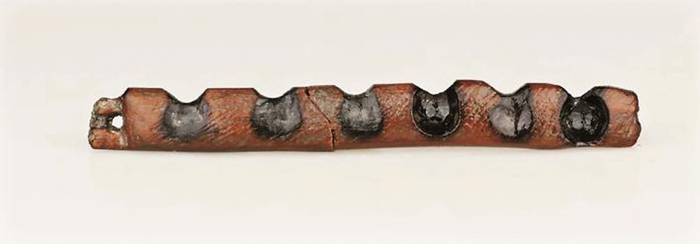
Key artifacts unearthed at the Caoyangang Site include a stone yue, an axe-shaped ceremonial artifact, which is the earliest discovered stone yue in Jiangsu province. Other significant finds include a drill wood igniter with visible drilling holes and fire burn marks. The site has also revealed more than 1,600 bone artifacts such as spade-shaped farm tools, boot-like artifacts, arrowheads, hair clasps, daggers, awls, and needles, which are finely crafted and polished.
Architectural and Cultural Insights
The architectural discoveries at the site include house foundations mainly constructed from reeds and wood. For instance, Foundation No. 4 spans 11 meters in length from east to west and 7.7 meters in width, constructed with wood and reeds. A wooden fence creates a semicircular enclosure on the southwestern and southern sides, while a reed fence or wall is located inside the wooden fence. In the early stages of the site, reed architecture was common, but later, wood structures became more advanced. The refuse pits at the site, totaling 151, exhibit traces of sunmao (mortise-and-tenon) joints, suggesting they are wooden architectural components. Some pits are paved with mat and clamshell.
Subsistence and Environmental Adaptation
The Caoyangang Site provides insights into ancient people's subsistence. Researchers have identified plant remains or seeds of water chestnuts, rice, Gorgon fruit, and wild soybean. The rice remains are identified as cultivated rice, indicating that agriculture, particularly rice farming, was a significant aspect of early settlers' livelihood. Animal remains include domesticated pigs and wild animals, showing that hunting and fishing were primary methods of acquiring meat alongside livestock domestication. The site's preservation is remarkable given its low-lying location vulnerable to sea transgressions.








